MemoHoney Official Website › Articles › Ingredient forms
Ingredient formsCitrulline Malate: What the Malate Half Actually Does
Citrulline malate is two molecules, and nearly every article about it discusses only one. Malic acid is a citric acid cycle intermediate, it is why the sports literature used this form, and it changes what a stated gram figure actually means. Whether it adds a benefit has barely been tested.
A salt has two halves and only one gets talked about
Citrulline malate appears on more supplement labels than plain citrulline does, and almost every article written about it discusses the citrulline. That is understandable, because citrulline is the part with the mechanism. It is also incomplete, because the reason the sports literature is full of citrulline malate rather than citrulline hydrochloride has as much to do with the malate as with anything else.
This article is about that second half: what malic acid is, what it does inside a cell, why it ended up bonded to citrulline in the first place, and whether it adds anything a buyer should care about. The short version is that it is a real metabolic intermediate with a real job, and that the evidence it adds anything beyond a delivery convenience is thinner than the marketing suggests.
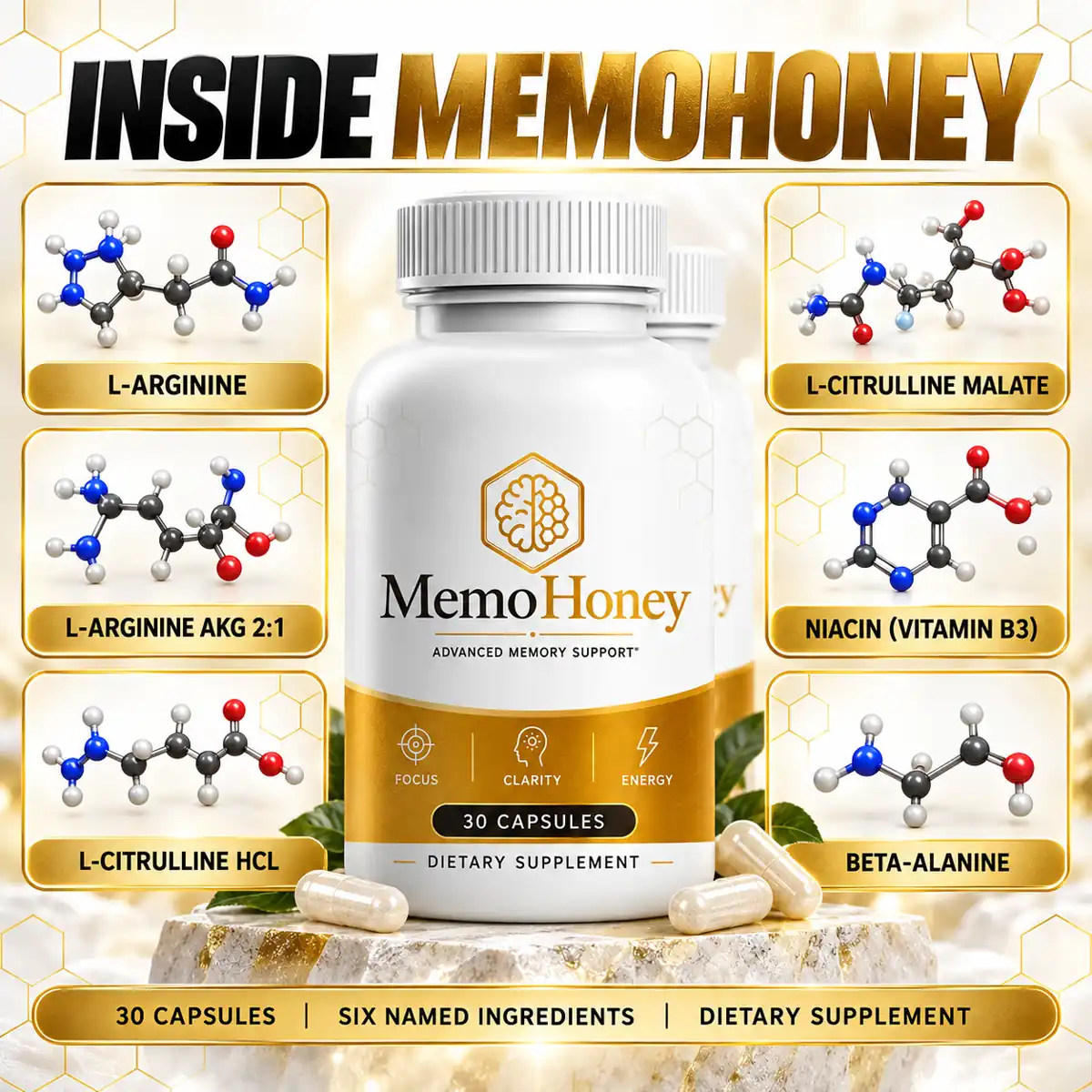
MemoHoney names both L-Citrulline HCL and L-Citrulline Malate, which is unusual enough to be worth understanding. Carrying two salts of one molecule is a choice, and it is the kind of choice that is either thoughtful or decorative depending on the amounts, which this artwork does not state.
What follows is a piece about a supplement, written by a counter that sells one. It is not clinical guidance and it cannot be. If forgetfulness has moved from irritating to worrying, or if somebody who sees you often has started mentioning it, that belongs with a clinician and not in a shopping decision. MedlinePlus is a plain-language starting point for which changes are worth raising.
What malate actually is
Malic acid is a four-carbon dicarboxylic acid. It is the compound that makes unripe apples taste sharp, it is used as a food acidulant, and inside every cell in your body it is one of the eight intermediates of the citric acid cycle, the loop that extracts energy from fuel and hands electrons to the chain that makes ATP.
That last point is what the marketing leans on. If malate is a step in the energy cycle, the argument runs, then swallowing more of it should feed the cycle and produce more energy. It is an appealing story and it has the structure of a great many supplement arguments: a real molecule, a real pathway, and a leap at the end from presence to sufficiency.
The leap is the problem. Citric acid cycle intermediates are not usually in short supply; the cycle is regulated by demand and by the availability of the fuels feeding into it rather than by how much malate is floating about. Topping up an intermediate does not obviously accelerate a cycle that was never waiting for it.
Why the sports trials used the malate form
Read the citrulline literature in date order and a pattern appears. The early vascular and clinical work used citrulline or citrulline hydrochloride. The performance work, which is most of the volume, used citrulline malate almost exclusively.
There are two ordinary reasons for that and neither is exciting. The first is supply: citrulline malate was the form the ingredient manufacturers were selling in bulk to the sports market, so it was the form the researchers could buy. The second is taste and handling, which matters more than it sounds when a trial requires participants to drink eight grams of something in water every day for several days.
The consequence is that when somebody says the trials used eight grams, they usually mean eight grams of citrulline malate rather than eight grams of citrulline. Those are different quantities of the active molecule, because the malate is part of the weight. Ratios of two to one and one to one both appear in the literature, which means the same stated dose can hide a difference of a third in the citrulline actually delivered.
| Form | Where it shows up | What the number on the label means |
|---|---|---|
| L-Citrulline | Vascular and clinical work | The whole stated weight is citrulline |
| L-Citrulline HCL | Powders and capsules, for stability and handling | Most of the weight is citrulline; some is hydrochloride |
| L-Citrulline Malate 2:1 | Most sports performance trials | Roughly two thirds citrulline by weight |
| L-Citrulline Malate 1:1 | Some products and some trials | Roughly half citrulline by weight |
This is the single most common confusion in the citrulline literature, and it is why a stated gram figure is only useful alongside the form it refers to. MemoHoney names two forms and states no ratio for either.
What the trials that used it actually found
Set the chemistry aside and look at outcomes. A three-day trial in male team-sport athletes gave eight grams a day and measured repeated sprint running performance. A double-blind pilot compared eight grams against twelve grams acutely on resistance exercise, which is exactly the comparison somebody should run when they suspect a dose is the variable. A six-week trial in physically active older women used three grams a day alongside training and measured lower-limb function.
Read together, that is a modest and mixed literature in athletic populations at amounts between three and twelve grams a day. It is not nothing. It is also not a cognitive literature, and none of those trials measured anything to do with memory.
For the vascular half of the story the better evidence sits with plain citrulline. A 2025 meta-analysis pooled citrulline and watermelon studies in middle-aged and older adults and found a modest reduction in systolic blood pressure. A review of citrulline in older adults sets out where the vascular and muscular benefits sit alongside exercise.
Hold this article next to the MemoHoney bottle it is about
Every name that appears on the artwork, set against the quantity its own published trial ran at, with two months from payment to change your mind about the whole thing.
From $49 a bottle on six · $158 is the smallest order · two months from the day you pay to change your mind
Take Me To The MemoHoney CheckoutRun MEM-26/ME-7839 · a bottle is 30 mornings · posted inside the United States
So does the malate add anything?
Honestly: probably a little, and less than the label implies.
The strongest reading is that malate improves palatability and handling, comes with a small theoretical contribution to acid buffering, and does no harm. The weakest reading is that it is a manufacturing convenience that acquired a marketing story. The literature does not cleanly separate the two, because almost nobody has run citrulline against citrulline malate at matched citrulline doses and measured the difference.
That absence is the point worth taking away. When a supplement names a specific salt, ask whether anyone has tested the salt against the plain compound. For citrulline malate the answer is mostly no, and a claim that rests on a comparison nobody has run is a claim resting on a hypothesis.
- Malate is a genuine metabolic intermediate, not an invented ingredient
- The sports literature used the malate form for supply and palatability reasons as much as for any biological one
- A stated gram figure means different amounts of citrulline depending on the ratio, and the ratio is frequently unstated
- Almost nobody has compared the two forms at matched citrulline doses, so claims of superiority are hypotheses
What that means for this particular label
MemoHoney names L-Citrulline HCL and L-Citrulline Malate as two of six ingredients, with no amount for either and no ratio for the malate. A reader can therefore establish that the formula contains citrulline in two salts and nothing further from the packaging.
That is a smaller piece of information than it appears, and it is also not nothing. Two salts of the same molecule is a defensible formulation choice: different salts dissolve at different rates and a formulator may be aiming at a slightly wider window of absorption. It is equally consistent with a label built to list six things rather than four.
The way to settle it is to ask. The order desk at the foot of this page will take the question, and a seller who can give a milligram figure and a ratio is telling you something useful. The ingredients page on this site sets each of the six beside the trial that studied it.
One last practical note. If you already use a citrulline malate powder for training, you are taking the same molecule at a much larger scale than any capsule can hold, and adding this one changes very little except your morning routine. That is worth knowing before spending money twice on the same idea.
The same question, asked of any salt on any label
Citrulline malate is the example here, but the habit of mind it teaches is worth more than the example. Supplement labels are full of salts, esters and complexes, and each one carries the same three questions.
First, how much of the stated weight is the active molecule? A salt always adds mass, and sometimes it adds a great deal. This label also carries L-Arginine AKG 2:1, which is arginine bound to alpha-ketoglutarate at two parts to one, so a third of that ingredient by name is not arginine at all. A label stating a total weight for a salt is stating a number larger than the amount of active it delivers.
Second, was the form tested, or was the plain compound tested and the form assumed? For arginine alpha-ketoglutarate the form itself was tested: the pharmacokinetic trial ran on the salt at twelve grams a day, and an acute trial ran three grams before a single session and found nothing. That is a real literature about a real form, which is more than most salts have.
Third, does the second half do anything by itself? For malate the answer is a cautious maybe. For hydrochloride it is a clear no: it is there for stability and handling and nobody claims otherwise. A label that claims the second half of a salt is an active ingredient in its own right has made a claim worth checking.
- A salt weight is always larger than the active weight inside it
- Two to one and one to one ratios are both common and are rarely stated on a front label
- Ask whether the form was tested or the plain compound was tested
- Hydrochloride is a handling decision; malate is at least arguable; anything presented as a second active deserves a source
- 2024 · Eur J Sport Sci · Faria with others · Effects of 3 days of citrulline malate supplementation on short-duration repeated sprint running performance in male team sport athletes · record 38874989. https://pubmed.ncbi.nlm.nih.gov/38874989/
- 2026 · J Funct Morphol Kinesiol · Gough with others · The Comparative Effect of Acute Moderate- and High-Dose Citrulline Malate on Resistance Exercise Performance in Trained Individuals: A Double-Blind Randomised Controlled Pilot Trial · record 41900522. https://pubmed.ncbi.nlm.nih.gov/41900522/
- 2026 · Clin Nutr ESPEN · Ramos-Hernández with others · Short-term citrulline malate supplementation enhances lower-limb function in physically active older women: A pilot randomized controlled trial · record 42162613. https://pubmed.ncbi.nlm.nih.gov/42162613/
- 2025 · Clin Nutr ESPEN · Luo with others · Does l-citrulline supplementation and watermelon intake reduce blood pressure in middle-aged and older adults? A systematic review and meta-analysis of randomized controlled trials · record 40789388. https://pubmed.ncbi.nlm.nih.gov/40789388/
- 2020 · Exerc Sport Sci Rev · Figueroa with others · L-Citrulline Supports Vascular and Muscular Benefits of Exercise Training in Older Adults · record 32568925. https://pubmed.ncbi.nlm.nih.gov/32568925/
- 2007 · Am J Physiol Gastrointest Liver Physiol · Rougé with others · Manipulation of citrulline availability in humans · record 17901164. https://pubmed.ncbi.nlm.nih.gov/17901164/