MemoHoney Official Website › Ingredients
IngredientsMemoHoney Ingredients: All Six Names, and What Each One Was Tested At
Six ingredients are named on the MemoHoney artwork and no amount is printed for any of them. Four aim at nitric oxide, one is a vitamin the body turns into NAD, and one raises a buffering molecule over weeks. Each is set out below beside the trial that studied it, the population it studied, and the amount that trial used.
The vendor ships a six-tile graphic headed INSIDE MEMOHONEY, and it is the most specific document in the whole pack. It names six compounds and carries no quantity for any of them, so the useful thing a retail desk can add is the other half of the comparison.
What the MemoHoney tile graphic actually prints
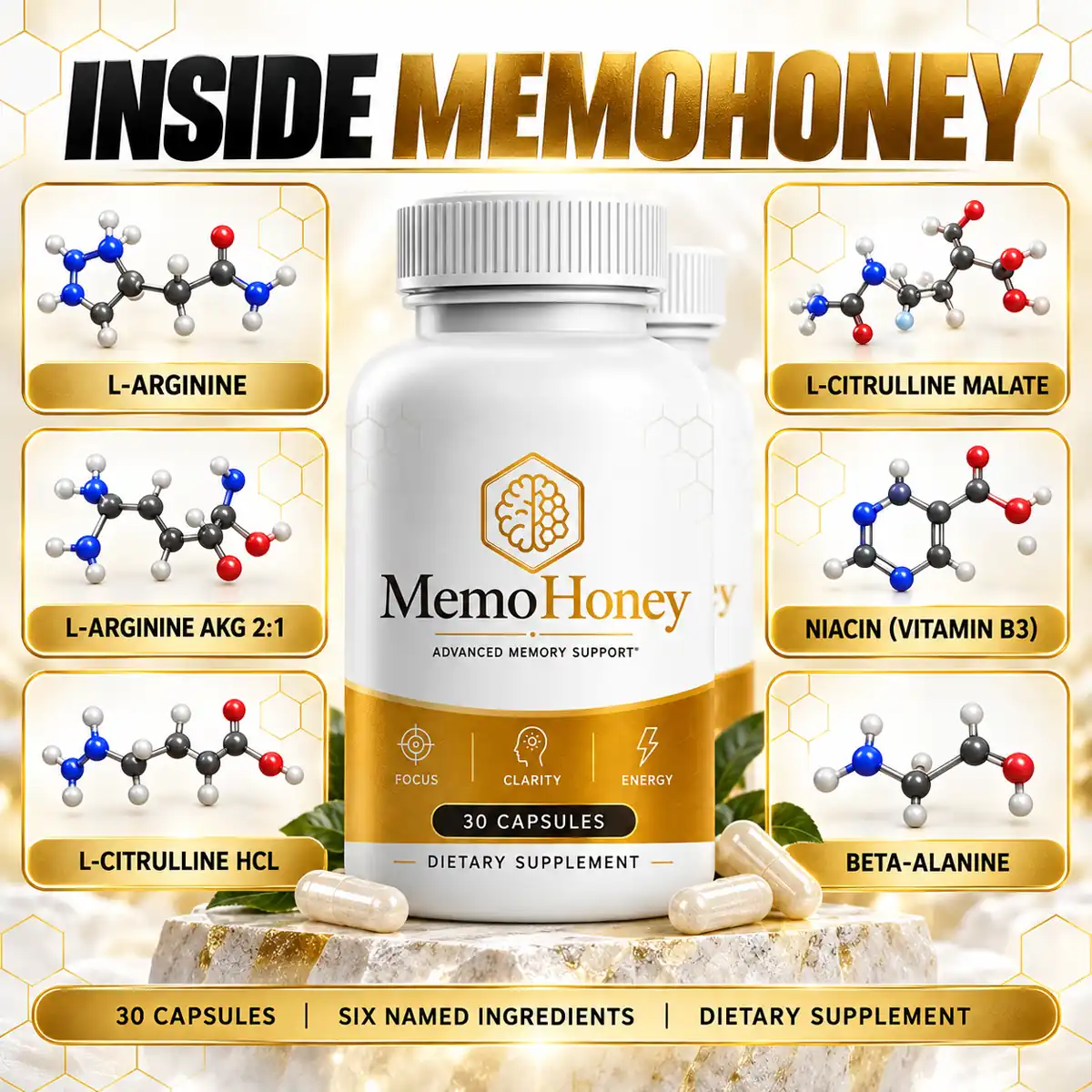
Read the tiles clockwise and the logic of the formula appears. L-Arginine and L-Arginine AKG 2:1 are the direct route to nitric oxide. L-Citrulline HCL and L-Citrulline Malate are the indirect route, which by mouth is the better one. Niacin sits on its own as the energy vitamin. Beta-Alanine sits on its own as the buffer. That is a coherent formula rather than a shopping list, and it is worth saying so before any of the criticism starts.
What the graphic does not carry is a Supplement Facts panel. No serving size, no milligram, no percent Daily Value, no Other Ingredients line. That is unusual enough to be worth stating plainly rather than hoping a reader will not notice, and it is the reason every card below carries a research amount rather than a label amount.
The six MemoHoney ingredients, one card each
Each card carries what the molecule does, where its human literature sits, and the amount a published trial actually used. The label's own column stays empty, because an invented number would be worse than no number.
L-Arginine
Amino acidThe molecule an enzyme turns straight into nitric oxide, and the one the gut and liver take the biggest cut of.
Nitric oxide synthase converts arginine directly into nitric oxide, a gas that survives seconds and tells the muscle wrapped around a blood vessel to let go. Wider vessel, easier flow. The catch is the journey: swallow arginine and most of it is broken down in the gut wall and the liver before it reaches the circulation at all.
Where the published work sits: Vascular function, pressure and exercise capacity, in humans.
What a trial used: Whole grams a day in the supplement work. One isotope study followed a single labelled meal to see what fraction of it ever became the gas. See a stable-isotope study of dietary arginine.
L-Arginine AKG 2:1 Extract
Amino acid saltArginine bound to alpha-ketoglutarate, two parts to one. A pre-workout ingredient with a mixed record.
Two parts arginine to one part alpha-ketoglutarate, sold on the idea that the salt gets further than plain arginine does. The pharmacokinetic work found the plasma arginine rise it promises; the performance work mostly did not find the performance.
Where the published work sits: Trained young men, lifting and forearm blood flow.
What a trial used: Three servings of 4 g across a day, twelve grams in all, in the trial that tracked what reached the plasma. See the arginine AKG pharmacokinetic trial.
L-Citrulline HCL
Amino acid saltThe precursor that slips past the first pass, then becomes arginine at the kidney.
Citrulline avoids the enzymes that strip out most oral arginine, and the kidney converts it to arginine afterwards. Gram for gram it raises blood arginine more reliably than arginine itself, which is the reason a formula aiming at nitric oxide reaches for citrulline at all.
Where the published work sits: Blood flow inside the skull, measured during sprint intervals.
What a trial used: Just under nine grams every day for five consecutive days, in athletes. See the citrulline cerebrovascular trial.
L-Citrulline Malate
Amino acid saltThe same citrulline carried on malic acid, and the form most of the sports trials actually used.
Identical citrulline, bound to malic acid rather than hydrochloride. Malate is an intermediate in the cycle cells use to make energy, which is where the second half of the marketing story comes from. Nearly every repeated-sprint and resistance trial in this literature used this form.
Where the published work sits: Repeat sprinting, lifting, and one pilot in older women.
What a trial used: Eight grams daily over three days, and a pilot that set eight against twelve in a single session. See a three-day citrulline malate trial.
Niacin (Vitamin B3)
VitaminThe raw material for NAD and NADP, the two electron shuttles every cell runs its energy on.
The body converts niacin into NAD and NADP, which carry electrons through energy metabolism in a neuron exactly as they do everywhere else. Run short of it badly enough and the result is pellagra, whose third classical symptom is dementia. That is a deficiency disease, not an argument for taking more than you need.
Where the published work sits: Observed in a Chicago ageing cohort, which is not a trial.
What a trial used: Ordinary food intakes, tens of milligrams daily. The supplemental ceiling set in the United States is 35 mg. See the Chicago Health and Aging Project analysis.
Beta-Alanine
Amino acidThe slow half of carnosine, an acid buffer that is also present in brain tissue.
Carnosine is two amino acids joined together, and beta-alanine is the one that runs out first. Supplying it is what raises carnosine; the other half is never short. Carnosine buffers acid inside working muscle, and a small imaging trial measured changes in two brain regions in people aged 60 to 80.
Where the published work sits: Work capacity, and a single small scanning study in the over-sixties.
What a trial used: Two point four grams daily in the scanning study, and a band of 3.2 to 6.4 grams across the pooled exercise work. See the beta-alanine brain-imaging trial.
Why MemoHoney carries citrulline as well as arginine
This is the detail that separates a formula somebody thought about from a formula somebody copied, and it is worth four paragraphs.
Arginine is the molecule an enzyme converts into nitric oxide. Swallowing arginine therefore looks like the obvious move, and for thirty years it was the move everybody made. The problem is arithmetic in the gut: an enzyme called arginase in the intestinal wall and the liver takes a very large cut before any of it reaches the circulation. A stable-isotope study followed a labelled dietary dose through that route in humans and is the reason the size of the losses is known rather than guessed.
Citrulline avoids the problem entirely. It is not a substrate for arginase, so it passes the gut and the liver intact, and the kidney then converts it into arginine inside the circulation where it is wanted. A human availability study manipulated citrulline intake directly and measured the result. Gram for gram, citrulline raises plasma arginine more reliably than arginine does, which is the whole reason a serious nitric-oxide formula reaches for it.
So a formula carrying both is hedging in a reasonable direction: the direct substrate for whatever survives, and the precursor that reliably does. One pharmacokinetic study gave the two together and measured the plasma response. What none of that establishes is the amount needed, and that is the next section's job.
What the trials used, next to what the MemoHoney label says
The right-hand column is the useful one. Every figure in it came out of the record of the trial named beside the ingredient, resolved through the NCBI summary service in this build. Five of the six ran in grams a day of a single compound taken alone. The sixth, niacin, is measured in milligrams and has a published ceiling.
A capsule of the shape used for a product like this holds a few hundred milligrams of powder altogether. Six ingredients sharing that space cannot each be at the amounts in the right-hand column, and no arrangement of the numbers changes that. This is arithmetic rather than an accusation, and it is true of every once-daily multi-ingredient capsule sold in this category.
Two useful moves. Ask the seller directly on +1 (302) 200-3480 for the milligram figure per capsule; it is a fair question and the answer, or the absence of one, is information. And read the niacin line first, because it is the one ingredient here whose useful amount fits comfortably inside a capsule and therefore the one most likely to be doing something at whatever dose is in there.
The MemoHoney ingredients this formula does not contain
Naming absences is usually padding. Here it is informative, because the things this formula leaves out are the things the category is built on.
There is no ginkgo biloba, which is the most studied herb in this aisle and whose largest trial, the Ginkgo Evaluation of Memory study, followed more than three thousand older adults for six years and found no prevention of dementia. There is no bacopa, no huperzine, no vinpocetine and no phosphatidylserine. There is no caffeine and no other stimulant, which is worth knowing for anyone who has been caught out by a focus product that turned out to be coffee in a capsule.
There is also nothing here that an analytical survey would flag as a drug. One such survey found an unapproved prescription compound in products sold as cognitive-enhancement supplements. A label naming six ordinary amino acids and a B vitamin is a label whose risks can be reasoned about, and that is worth more than it sounds.
How this MemoHoney ingredient page was compiled
- Mariotti F, Petzke KJ, Bonnet D, et al. Kinetics of the utilization of dietary arginine for nitric oxide and urea synthesis: insight into the arginine-nitric oxide metabolic system in humans. Am J Clin Nutr. 2013;97(5):972-9. PMID 23535108. https://pubmed.ncbi.nlm.nih.gov/23535108/
- Khalaf D, Krüger M, Wehland M, et al. The Effects of Oral l-Arginine and l-Citrulline Supplementation on Blood Pressure. Nutrients. 2019;11(7):1679. PMID 31336573. https://pubmed.ncbi.nlm.nih.gov/31336573/
- Morita M, Hayashi T, Ochiai M, et al. Oral supplementation with a combination of L-citrulline and L-arginine rapidly increases plasma L-arginine concentration and enhances NO bioavailability. Biochem Biophys Res Commun. 2014;454(1):53-7. PMID 25445598. https://pubmed.ncbi.nlm.nih.gov/25445598/
- Campbell B, Roberts M, Kerksick C, et al. Pharmacokinetics, safety, and effects on exercise performance of L-arginine alpha-ketoglutarate in trained adult men. Nutrition. 2006;22(9):872-81. PMID 16928472. https://pubmed.ncbi.nlm.nih.gov/16928472/
- Li A, Li H, Chen J. The effects of L-citrulline supplementation on cerebrovascular function during sprint interval training in taekwondo athletes. J Exerc Sci Fit. 2025;23(3):222-228. PMID 40474881. https://pubmed.ncbi.nlm.nih.gov/40474881/
- Rougé C, Des Robert C, Robins A, et al. Manipulation of citrulline availability in humans. Am J Physiol Gastrointest Liver Physiol. 2007;293(5):G1061-7. PMID 17901164. https://pubmed.ncbi.nlm.nih.gov/17901164/
- Luo P, Chen J, Liu K, et al. Does l-citrulline supplementation and watermelon intake reduce blood pressure in middle-aged and older adults? A systematic review and meta-analysis of randomized controlled trials. Clin Nutr ESPEN. 2025;69:653-664. PMID 40789388. https://pubmed.ncbi.nlm.nih.gov/40789388/
- Faria VS, Egan B. Effects of 3 days of citrulline malate supplementation on short-duration repeated sprint running performance in male team sport athletes. Eur J Sport Sci. 2024;24(6):758-765. PMID 38874989. https://pubmed.ncbi.nlm.nih.gov/38874989/
- Gough LA, Tan R, Bailey SJ, et al. The Comparative Effect of Acute Moderate- and High-Dose Citrulline Malate on Resistance Exercise Performance in Trained Individuals: A Double-Blind Randomised Controlled Pilot Trial. J Funct Morphol Kinesiol. 2026;11(1). PMID 41900522. https://pubmed.ncbi.nlm.nih.gov/41900522/
- Morris MC, Evans DA, Bienias JL, et al. Dietary niacin and the risk of incident Alzheimer's disease and of cognitive decline. J Neurol Neurosurg Psychiatry. 2004;75(8):1093-9. PMID 15258207. https://pubmed.ncbi.nlm.nih.gov/15258207/
- Minto C, Vecchio MG, Lamprecht M, et al. Definition of a tolerable upper intake level of niacin: a systematic review and meta-analysis of the dose-dependent effects of nicotinamide and nicotinic acid supplementation. Nutr Rev. 2017;75(6):471-490. PMID 28541582. https://pubmed.ncbi.nlm.nih.gov/28541582/
- Ostfeld I, Zamir A, Ben-Zeev T, et al. β-Alanine supplementation improves fractional anisotropy scores in the hippocampus and amygdala in 60-80-year-old men and women. Exp Gerontol. 2024;194:112513. PMID 38971131. https://pubmed.ncbi.nlm.nih.gov/38971131/
- Saunders B, Elliott-Sale K, Artioli GG, et al. β-alanine supplementation to improve exercise capacity and performance: a systematic review and meta-analysis. Br J Sports Med. 2017;51(8):658-669. PMID 27797728. https://pubmed.ncbi.nlm.nih.gov/27797728/
- DeKosky ST, Williamson JD, Fitzpatrick AL, et al. Ginkgo biloba for prevention of dementia: a randomized controlled trial. JAMA. 2008;300(19):2253-62. PMID 19017911. https://pubmed.ncbi.nlm.nih.gov/19017911/
- Cohen PA, Avula B, Khan I. The unapproved drug centrophenoxine (meclofenoxate) in cognitive enhancement dietary supplements. Clin Toxicol (Phila). 2022;60(10):1156-1158. PMID 35959800. https://pubmed.ncbi.nlm.nih.gov/35959800/
Six named MemoHoney ingredients, one capsule a morning
The ladder starts at two bottles, which is sixty mornings and the same length as the refund window. Three bottles adds free postage and the five downloads.
From $49 a bottle on six · $158 is the smallest order · two months from the day you pay to change your mind
Take Me To The MemoHoney CheckoutRun MEM-26/ME-7839 · a bottle is 30 mornings · posted inside the United States