MemoHoney Official Website › Articles › Reading the bottle
Reading the bottleMemoHoney's 30-Capsule Label: What It Can Confirm, and What It Cannot
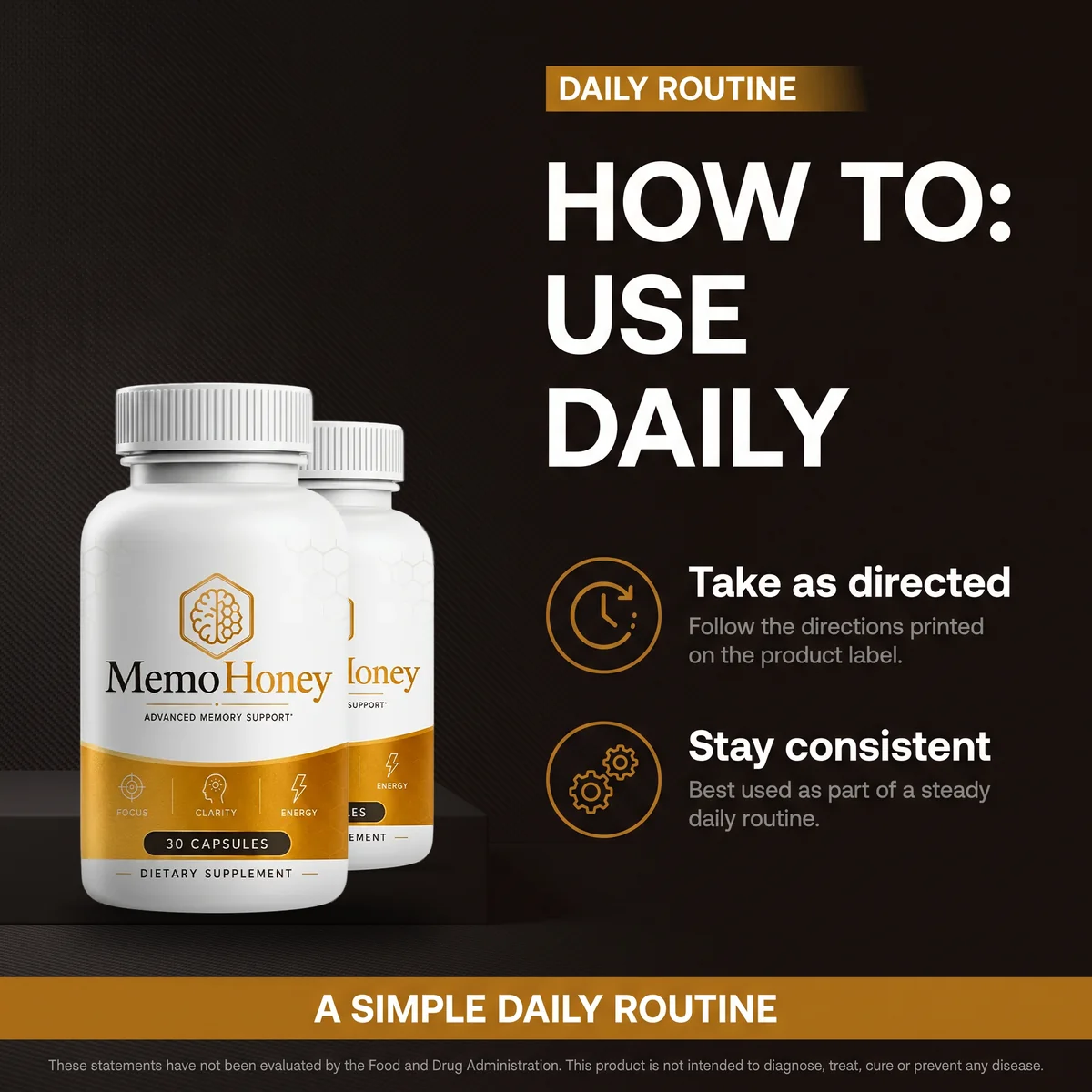
Thirty capsules and one capsule daily establish a thirty-day routine. They do not establish an ingredient amount, a clinical outcome, or a reason to take more after a missed day. The supplied label is most useful when it is read at that exact level of certainty.
Thirty is the number that changes the whole reading
The most useful number on a MemoHoney bottle is not a claim word. It is the small line that says 30 capsules. Paired with the direction to take one capsule daily, it turns the bottle into a thirty-day routine. That sounds elementary, but it prevents three common mistakes: assuming a serving contains several capsules, assuming a bottle covers the sixty-day return window, and treating a pack photograph as proof of an ingredient amount.
This article is deliberately a label-reading exercise, not a promise about results. The supplied MemoHoney pack names six ingredients but does not supply a Supplement Facts panel, serving weights, or a milligram amount for any of them. The honest starting point is therefore narrow: one capsule per day, thirty capsules per bottle, and six named compounds. Everything beyond that needs either a printed label, a seller answer, or a clinician's advice.
What follows is a piece about a supplement, written by a counter that sells one. It is not clinical guidance and it cannot be. If forgetfulness has moved from irritating to worrying, or if somebody who sees you often has started mentioning it, that belongs with a clinician and not in a shopping decision. MedlinePlus is a plain-language starting point for which changes are worth raising.
What the supplied pack actually lets a reader say
| Printed or supplied detail | What it establishes | What it does not establish |
|---|---|---|
| 30 capsules | One bottle has thirty individual capsules | How much of any compound is in one capsule |
| Take 1 capsule daily | The stated routine is one per day | That a routine will suit every adult |
| Six named ingredients | Which six compounds the formula names | Their rank, amount, or combined dose |
| Dietary supplement | The product category | That it diagnoses or treats memory loss |
| Authorized outlet details | Who can answer order questions | That a seller can give medical advice |
This distinction is not pedantry. A label can be read faithfully without being stretched into information it does not print.
The direction supplies a clear unit: one morning equals one capsule. If a reader chooses to follow the label, the practical record is also clear: count the first morning as day one and the thirtieth capsule as day thirty. A calendar note is more reliable than trying to reconstruct a routine from a partly empty bottle later.
The ingredient list is equally concrete but has a different limit. It names L-Arginine, L-Arginine AKG 2:1 Extract, L-Citrulline HCL, L-Citrulline Malate, Niacin, and Beta-Alanine. Those names enable safety questions. They do not reveal dose. A six-ingredient list is not six quantified doses, and it should never be used to imply that a study of a gram-scale single compound was a study of this one capsule.

How a thirty-capsule bottle maps to a real routine
A once-daily direction is simplest when it is attached to something that already happens. The label says preferably in the morning before a meal with a glass of water. That gives a specific anchor: bottle, water, then breakfast. The aim of an anchor is not to make the product stronger. It is to make a routine honest enough that a person knows whether they actually followed it.
There is also a safety reason not to improvise a larger serving after a missed day. The pack gives a one-capsule direction. It gives no instruction to double a dose, no amounts from which to calculate a replacement, and no reason to treat two capsules as equivalent to one missed morning. If a direction is unclear for a particular person, the sensible next step is a pharmacist or the clinician who knows their medicines, not an arithmetic guess.
- Read the front and direction line together. Thirty capsules and one daily means a thirty-day bottle.
- Choose the stated morning anchor. Keep the bottle where the water routine happens, not where it will be forgotten.
- Mark the start date. The date is useful for a routine and for knowing when the bottle is close to empty.
- Do not make up a catch-up dose. The supplied material only supports the written one-capsule direction.
- Keep the bottle and the order record. They identify the product and the purchase if an order question follows.
Three questions a one-capsule direction cannot answer
The first question is whether the listed ingredients fit with a person's medicines and conditions. This is particularly important for anyone using a nitrate, a blood-pressure medicine, or a PDE5 inhibitor: several named ingredients sit in nitric-oxide-related research, and a clinician or pharmacist is the appropriate person to consider the whole medication list. The same applies to a history of reactions to niacin or beta-alanine.
The second is quantity. The supplied pack contains no milligram amounts. A reader can see that citrulline and arginine are named, but cannot compare the amount in one capsule to a study without first obtaining an actual amount. A published study is not a permission slip to infer a dose from a product photograph.
The third is purpose. The seller frames the product as support for memory function, cognitive health, clarity, neural communication, focus, and concentration. These are structure-and-function statements, not evidence that the capsule treats dementia, mild cognitive impairment, or a worrying change in memory. The FDA's consumer guidance is a useful boundary for how dietary-supplement claims differ from disease treatment.
- Bring the six names to a pharmacist if you take medicines or have a medical condition
- Ask for a written amount before comparing a listed ingredient with a study
- Use the stated one-capsule routine rather than creating a replacement serving
- Treat memory changes that worry you or someone close to you as a clinical question

Hold this article next to the MemoHoney bottle it is about
Every name that appears on the artwork, set against the quantity its own published trial ran at, with two months from payment to change your mind about the whole thing.
From $49 a bottle on six · $158 is the smallest order · two months from the day you pay to change your mind
Take Me To The MemoHoney CheckoutRun MEM-26/ME-7839 · a bottle is 30 mornings · posted inside the United States
A first month is a record, not a verdict
Thirty days is long enough to establish whether a daily routine is practical, but it is not a diagnostic test and it does not turn a personal impression into a clinical result. If someone elects to try a supplement after considering the label, a small record is more useful than a changing recollection: the start date, the usual time, missed days, and a single pre-chosen everyday task. Keep the task modest and stable; do not replace it midway with an easier one.
The point of the record is equally valuable if the answer is no. A clean no after a consistent routine is better information than a month of sporadic use interpreted through hope. It also keeps the claim language in proportion. A bottle's calendar is not a substitute for sleep, hearing care, blood-pressure care, exercise, or medical assessment when memory has become a concern. Those are different categories of action.
A useful check is concrete, not dramatic
A practical check does not ask whether a person has become sharper in every part of life. It asks a single question that existed before the bottle arrived: for example, whether the morning routine happened on the intended days, or whether a familiar calendar task was completed without changing the task itself. The answer may still be uncertain, and uncertainty is allowed. The value is that it does not invite a person to reinterpret an ordinary good or bad day as proof.
If a reaction occurs, stop treating the notes as an experiment to finish. Record what was taken and when, and seek appropriate medical advice. The page's label-reading method is meant to avoid overclaiming on either side: neither a vague improvement nor a bottle count should be promoted into a medical conclusion.
- Thirty capsules plus one daily is a thirty-day routine
- The pack names six ingredients but supplies no amounts for them
- A named ingredient is not proof that the capsule matches a study's dose
- Use the written direction; do not invent a catch-up serving
- For medicines, side effects, or concerning memory change, ask a qualified clinician
Where to check the next fact
The how-to-use page repeats the label direction and the ingredients page keeps the six names in one place. The testing and quality page explains what the supplied lot and certificate references are, and are not. For purchase or order details, use the counter's listed contact details rather than assuming a product claim answers a service question.
That is the quiet value of reading a small label carefully. It narrows the claims to what is actually printed, separates questions the seller can answer from questions a clinician should answer, and leaves a reader with a routine they can describe without embellishing it.
- Questions and Answers on Dietary Supplements. U.S. Food and Drug Administration. https://www.fda.gov/food/information-consumers-using-dietary-supplements/questions-and-answers-dietary-supplements
- Using Dietary Supplements Wisely. National Center for Complementary and Integrative Health, National Institutes of Health. https://www.nccih.nih.gov/health/using-dietary-supplements-wisely
- Memory. MedlinePlus, U.S. National Library of Medicine. https://medlineplus.gov/memory.html
- Khalaf D, Krüger M, Wehland M, et al. The Effects of Oral l-Arginine and l-Citrulline Supplementation on Blood Pressure. Nutrients. 2019;11(7):1679. PMID 31336573. https://pubmed.ncbi.nlm.nih.gov/31336573/
- Dolan E, Swinton PA, Painelli VS, et al. A Systematic Risk Assessment and Meta-Analysis on the Use of Oral β-Alanine Supplementation. Adv Nutr. 2019;10(3):452-463. PMID 30980076. https://pubmed.ncbi.nlm.nih.gov/30980076/
- Minto C, Vecchio MG, Lamprecht M, et al. Definition of a tolerable upper intake level of niacin: a systematic review and meta-analysis of the dose-dependent effects of nicotinamide and nicotinic acid supplementation. Nutr Rev. 2017;75(6):471-490. PMID 28541582. https://pubmed.ncbi.nlm.nih.gov/28541582/