MemoHoney Official Website › Articles › The format
The formatWhat a Vegetable Capsule Shell Decides, and What It Cannot
A capsule shell decides three things: whether the product suits a vegetarian diet, how the contents are released, and how much powder fits at all. MemoHoney's seller describes a hypromellose vegetable capsule. That settles the first question completely and makes the third one measurable.
The part of a capsule nobody reads the label for
Every discussion of a capsule supplement is about what is inside it. The shell is treated as packaging: a tasteless container that dissolves and gets out of the way. It is more interesting than that, and on a label with no amounts printed it is one of the few things about the physical product that can actually be established.
A capsule shell decides three things a buyer cares about. Whether the product is suitable for a vegetarian or vegan diet. How and where the contents are released. And, most importantly for a formula like this one, how much powder the capsule can hold at all.
MemoHoney's seller describes a hypromellose vegetable capsule, and the pack carries a vegetarian emblem consistent with that. This article is about what that single sentence settles and what it leaves open.
What follows is a piece about a supplement, written by a counter that sells one. It is not clinical guidance and it cannot be. If forgetfulness has moved from irritating to worrying, or if somebody who sees you often has started mentioning it, that belongs with a clinician and not in a shopping decision. MedlinePlus is a plain-language starting point for which changes are worth raising.
Hypromellose against gelatin
Two materials dominate the capsule market. Gelatin is the older one: a protein derived from animal collagen, usually bovine or porcine. Hypromellose, also written HPMC, is hydroxypropyl methylcellulose, a modified plant cellulose.
The practical differences are small but real. Gelatin shells are slightly cheaper and have a very long track record. They also carry an animal origin, which rules them out for vegetarian and vegan diets and for several religious dietary requirements, and they become brittle in dry conditions and tacky in humid ones. Hypromellose is plant-derived, more tolerant of humidity, and generally a little slower to rupture in the stomach.
That last point is occasionally presented as a drawback and is almost never one in practice. A few minutes of difference in when a shell opens matters for a fast-acting medicine and does not matter at all for a daily supplement whose stated effects build over weeks.
| Gelatin | Hypromellose (HPMC) | |
|---|---|---|
| Origin | Animal collagen | Plant cellulose, chemically modified |
| Suitable for vegetarians | No | Yes |
| Behaviour in humidity | Softens and can stick | More stable |
| Behaviour when dry | Can become brittle | More stable |
| Typical rupture | Fast | Slightly slower, rarely of any consequence |
| Cost to the manufacturer | Lower | Slightly higher |
A product that chooses the more expensive shell has made a decision that costs it money, which is a small piece of evidence about how the formulation was approached.
The ceiling nobody prints on the bottle
Here is where the shell stops being a detail. Capsules come in standard sizes and each size holds a fixed volume. A size 0 capsule, which is the most common shape for a supplement of this kind, holds a few hundred milligrams of a typical powder. A size 00 holds more and is noticeably larger to swallow. Nothing in that range approaches a gram of anything.
That is an absolute physical limit and it is the most useful fact a reader can hold when a label names six ingredients and no amounts. Whatever else is unknown, the total mass of powder in one capsule is bounded, and the sum of six ingredients cannot exceed it.
Set that against the literature. The cerebrovascular citrulline trial used 8.8 grams a day. The arginine alpha-ketoglutarate kinetic trial used twelve grams a day in three doses. The beta-alanine meta-analysis covered 3.2 to 6.4 grams a day. One capsule cannot hold any single one of those figures, let alone several at once.
What the shell does rule out
A stated hypromellose shell settles a small number of questions completely, which on this label is worth something.
It rules out gelatin, which is the question most vegetarians and vegans are actually asking when they look at a supplement. It is consistent with the vegetarian emblem on the pack, so the emblem and the description agree rather than contradicting each other, which is not always the case. And it makes a dairy or gluten carrier in the shell itself a non-issue, although the fill is a separate question and the emblems covering it are formulation claims rather than published tests.
- A hypromellose shell contains no animal product
- It agrees with the vegetarian emblem printed on the pack, which is worth checking on any product where both are stated
- It says nothing about the fill, which is where the gluten and dairy questions actually live
- Anyone with coeliac disease should ask the seller for a tested figure in parts per million rather than relying on an emblem
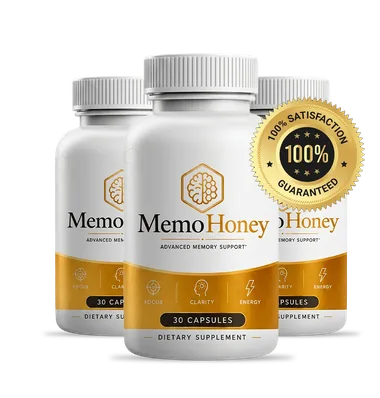
Hold this article next to the MemoHoney bottle it is about
Every name that appears on the artwork, set against the quantity its own published trial ran at, with two months from payment to change your mind about the whole thing.
From $49 a bottle on six · $158 is the smallest order · two months from the day you pay to change your mind
Take Me To The MemoHoney CheckoutRun MEM-26/ME-7839 · a bottle is 30 mornings · posted inside the United States
How a shell behaves in the place you keep it
Capsule shells respond to their surroundings, which is the practical reason storage advice exists on supplement bottles at all.
Heat and humidity are the two that matter. A bathroom cabinet is the worst common storage place in a house because it goes through a humidity cycle twice a day. A kitchen windowsill above a kettle manages heat and humidity at once. A bedside drawer or a cupboard away from the hob is unremarkable and fine.
Hypromellose is more tolerant of both than gelatin, so the risk here is lower than it would be with an older shell, but the fill is a different matter. Amino acid powders are hygroscopic: they draw moisture out of the air, clump, and eventually cake. A capsule that rattles loosely has kept dry; one that has obviously softened has not.
What to do with all of this
- Check the shell claim against the emblem. If a pack says vegetarian and the seller describes a vegetable capsule, the two agree. If they do not, ask why.
- Hold the volume ceiling in mind. It is the one hard number available on a label with no amounts, and it bounds every claim about strength.
- Store it somewhere boring. A cupboard, away from steam and sun, with the cap closed properly.
- Finish a bottle in a month. Thirty capsules at one a day is thirty days. A bottle still half full at week ten means the routine lapsed, and starting again with a fresh bottle is a better plan than finishing an old one out of thrift.
- Ask the questions the shell cannot answer. The fill, the amounts and the ratios are all outside what a shell description settles. The order line at the foot of this page is where to ask.
What a capsule buys, and what it costs
Format is a trade and it is usually presented as a preference. It is worth setting the two sides out properly, because on a formula built from amino acids the trade is unusually sharp.
A powder has no volume ceiling worth mentioning. A scoop can carry eight grams of citrulline malate without difficulty, which is why every trial in that literature used one. It is also why pre-workout products are sold in tubs rather than bottles: the amounts involved simply do not fit in anything smaller.
What a powder costs is adherence and taste. Beta-alanine is unpleasant loose, amino acids in water are sour and faintly savoury, and a scoop that needs measuring and stirring at seven in the morning is a scoop that gets skipped. Every trial in the world of supplement research runs into the same wall: a product nobody takes has no effect to measure.
A capsule inverts both. It tastes of nothing, it takes three seconds, it travels, and thirty of them make a month that ends visibly. That is a real advantage and it is the reason this format exists. The price of it is the ceiling, and the ceiling is not negotiable.
| Capsule | Powder | |
|---|---|---|
| How much fits | A few hundred milligrams of powder | As much as you can stir into a glass |
| Taste | None | Sour and savoury, and beta-alanine is worse than most |
| Effort each morning | Three seconds | Measuring, stirring, washing up |
| Travel | A bottle in a bag | A tub and a scoop |
| Adherence over eight weeks | High, on the evidence of this desk's reviews | Lower, on the evidence of every supplement study ever run |
| Can carry trial-scale amounts | No | Yes |
The bottom two rows are the trade in one line. A format that gets taken every day at a small dose and a format that gets abandoned at a large one are not easy to compare, and honest people land on different sides of it.
The shell is a small subject and this is a long article about it, which is deliberate. On a product whose artwork states six names and two counts, the things that can be established at all deserve to be established properly. The ingredients page handles the fill, and the testing page takes the ten emblems apart one at a time.
- 2025 · J Exerc Sci Fit · Li with others · The effects of L-citrulline supplementation on cerebrovascular function during sprint interval training in taekwondo athletes · record 40474881. https://pubmed.ncbi.nlm.nih.gov/40474881/
- 2006 · Nutrition · Campbell with others · Pharmacokinetics, safety, and effects on exercise performance of L-arginine alpha-ketoglutarate in trained adult men · record 16928472. https://pubmed.ncbi.nlm.nih.gov/16928472/
- 2017 · Br J Sports Med · Saunders with others · β-alanine supplementation to improve exercise capacity and performance: a systematic review and meta-analysis · record 27797728. https://pubmed.ncbi.nlm.nih.gov/27797728/
- Agency guidance · National Center for Complementary and Integrative Health, National Institutes of Health · Using Dietary Supplements Wisely. https://www.nccih.nih.gov/health/using-dietary-supplements-wisely
- Agency guidance · U.S. Food and Drug Administration · Questions and Answers on Dietary Supplements. https://www.fda.gov/food/information-consumers-using-dietary-supplements/questions-and-answers-dietary-supplements